Translate

about myself

Моя фотография
Starye Dorogi, Minsk Region, Belarus
Hello dear visitors! I'm a teacher of English in Gymnasia №1 in town Starye Dorogi. I'm also a facilitator of the iEARN project "Money Matters". I hope my blog will be a useful resource where you'll find a lot of different lexical and grammar exercices, presentations, lesson plans and workshops. If you have any questions, please, contact me by e-mail belozorovich@gmail.com

Поиск по этому блогу

Общее·количество·просмотров·страницы

popular messages

Показаны сообщения с ярлыком мероприятия. Показать все сообщения

24 окт. 2014 г.

On the 24th of October in Gymnasium No.1 of Starye Dorogi an exchange fair “FREE MARKET” was organized which was timed to celebration of the International Day for the Eradication of Poverty (which is celebrated in the world on the 17th of October).
        During 3 days students and teachers were brining thing, which they don’t need any more and which they’d like to present. Instead of their things they have got a coupon, where were written the number of things they have presented. During these days students and teachers have brought about 1500 thing – books, magazines, adornments, pictures, photo frames, school things, CDs and many other things. 


In the day of fair all participants with great pleasure and enthusiasm change their coupons on the liked things. Everybody was very pleased to get the thing which he needs most of all. To the end of the fair it was clear that «FREE MARKET» will become a new tradition of our Gymnasium. All toys, which have left, were presented to primary school students.


Don’t hurry to throw away your old thing, may be somebody needs them, and next year you’ll change them at our «FREE MARKET»!

22 окт. 2014 г.


To celebrate International Day for the Eradication of Poverty we decided to organize FREE MARKET which will take place in our Gymnasium on the 24th of October. We offered students and teachers to bring different thing which they don't need any more so that somebody could take them free. We'll tell more about our action after the 24th of October and send more photos.

5 мая 2011 г.

English Party


It's a team game. Participants are divided into two teams.

 Game 1 “A Telegram” 
Every team get a word from 4 letters. The task is to think a word on each letter in the word to make a logical sentence.
Model: West
We
Eat
Smashing
Tomatoes

Game 2 “An Artist”
You need two bags with the words ears, nose, face, lips, eyes, hair and two scarves to close eyes, two A4 papers and two markers. Every participant of the team pulls a word and draws it or them with close eyes on the piece of paper. As a result every team should draw a person.
 Game 3 “A Tail”
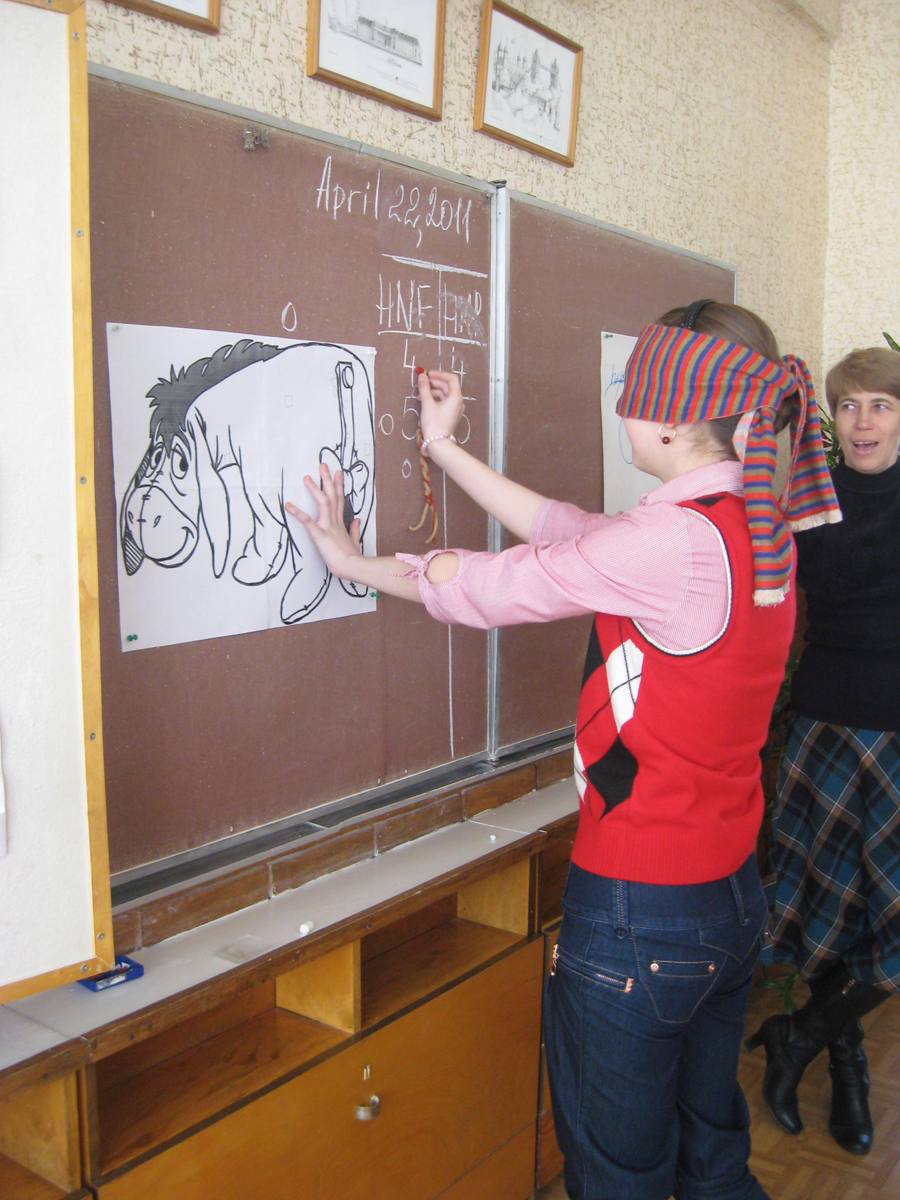
You need a large picture of a donkey, a scarf and a tail (make it from a rope). Every participants should try to fasten a tail to a donkey.

Game 4 “A Deaf Telephone”
Every team stands in a line and gets a very long sentence.
They should transfer it to each other.
Model: One day Little Red Riding Hood was running with a basket through the dark forest to her old Granny.

Game 5 “A Fridge”
You should prepare a picture of a fridge with a lot of products. Show the fridge to the teams during 10 seconds. They should write all the food they remembered.

Game 6 “A Ball”
The first participant takes a ball, name the word on letter B and pass it to the second participant. The second participant should name the word on the last letter of the previous word and so on.
Model: BananaAntTelephone ElephantTopicCake

Game 7 “Riddles”
1.  A dog before two dogs, a dog behind two dogs, one dog in the middle. How many dogs? (3)
2.  Steven lives with his father, his mother, his brother, a dog, two cats and two parrots. How many legs do they all have? (24)
3.  If you have it you want to share it. If you share it you do not have it. What is it? (a secret)
4.  One Sunday two weeks ago Ben said: “Yesterday we went to the cinema. Tomorrow we’ll go to the park”. On what day did they go to the park?
5.  My father has a son. He isn’t my brother. Who is he? (I myself)
6.  If a blue stone falls in the Black Sea what will happen?
(the stone will be wet)
Game 8 “Wordmaker”
Every team gets a very long word. During 1 minute they should write as many short wards as possible using only the letters of this word.
Model: interpretation (tea, pit, eat, pot, port, tin …)

16 янв. 2010 г.

Scottish Sport
HIGHLAND GAMES
  The Highland Games go back to contests of strength among the clans in ancient times, a way for the chiefs to choose the strongest men as their warriors. King Mael Coluim III, in the 11th Century, summoned contestants to a foot race to the summit of Craig Choinnich. This may have been the origin of today's modern Highland Games.
  During the Celtic revival of the early 19th Century, there was a renewed interest in the traditions of the clans of the Scottish Highlands. Various Highland Societies, beginning in the 1780s, began to organize events which eventually led to the Highland Games we know today.
   This modern revival of the Games received an enormous boost with the visit of King George IV to Scotland in 1822, although events had been held in previous years. In the 1840s, in Braemar, the Games began as a fundraising effort by local artisans and in 1848, Queen Victoria and Prince Albert began to patronize them. The following year, they were moved to the grounds of Balmoral Castle itself.
   In the 19th Century, Baron Pierre de Coubertin visited a number of athletic competitions in prepara­tion for the forthcoming Olympic Games, in order to examine the technical organization of such a com­petition. Among them, he visited a Highland Games event in conjunction with the Paris Exhibition of 1889. That event, in addition to what we today would call track and field events, also contained wrestling, tug-of-war, cycling, as well as competition in piping and dancing.


Heavy Athletic Events
Standard Highland athletics events:
Caber toss: a long tapered wooden pole is stood up­right and lifted by the competitor who balances it vertically in his hands. Then he runs forward and tosses it end-over-end, "turning the caber". Cabers vary greatly in length, weight, taper and balance.
Stone put: this event is similar to the modern-day shot put in the Olympic Games. However, instead of a steel shot, a large stone, of variable weight is often used.
Scottish hammer throw: this event is similar to the hammer throw in modern track and field competi­tions, though with some differences. In the Scottish event, a round metal ball is attached to the end of a shaft. With feet in a fixed position, the hammer is whirled about the head and thrown for distance over either shoulder.
Weight throw: This is two events, one using a light (28 lb) and the other a heavy (56 lb) weight made of metal with a handle attached. It is thrown with one hand and the longest throw wins. Weight over the bar, is where athletes at­tempt to toss a 56 pound weight with an attached handle over a horizontal bar using only one hand. Each athlete is allowed three attempts at each height.
Sheaf toss: A bundle of straw (the sheaf) weighing 20 pounds (9 kg) and wrapped in a burlap bag is tossed vertically with a pitchfork over a raised bar like that used in pole vaulting.


   Учителя английского языка гимназии №1 г. Старые Дороги 16 января провели среди учащихся 5-6-х классов свои "Шотландские забавы" . 


Ярлыки

мероприятия (4) проекты iEARN (4) LC (9)